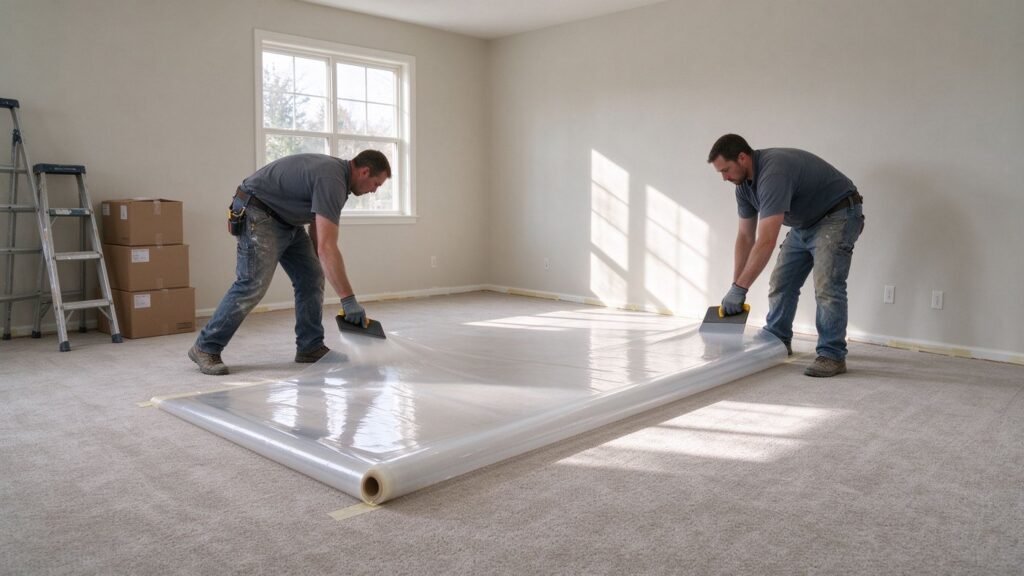
A different kind of carpet film article
Search “carpet protection film” and you get buying guides. That is not what this is.
We read through the 1–3 star reviews on carpet protection film listings — the big retail listings run into the hundreds of reviews, and roughly one in eight is a one-star — plus contractor forum threads and technical bulletins from carpet-care specialists. Nine complaints repeat, in almost the same words, across brands and countries:
“Did not stick well to carpet.” — verified purchaser, 2-star review
“It literally only sticks to itself and the scissors I used to cut it. It’s basically floating above the carpet.” — verified purchaser, 1-star review
“Too sticky to the core of film and doesn’t unroll in a nice even manner. Especially toward the end of the roll it is too hard to pull off the core.” — painting contractor, trade forum
What follows is a diagnosis manual. For each complaint: what the buyer wrote, what most likely happened, a 60-second test you can run on site, and the fix — split into application-side mistakes and product-side limits, because those two are not the same problem and blaming the wrong one wastes money.
If you are still at the stage of picking a film for a project, start with our renovation buyer’s guide instead and come back here when something goes wrong.
Complaint map
| # | What the buyer says | Most common real cause | Responsibility | Field test |
|---|---|---|---|---|
| 1 | “It won’t stick — it floats” | Dust, moisture, cold surface, or wrong tack for the pile | Both | Press-and-peel test |
| 2 | “The edges lift and slide” | Tack too low, dusty/damp face, narrow roll under traffic | Both | Foot-traffic replay |
| 3 | “It sticks to itself and won’t unroll” | Blocking, unwind tension, storage compression | Product | Core-pull test |
| 4 | “It left my carpet sticky” | Adhesive transfer: overrun window, damp carpet, heat | Both | Cotton-swab test |
| 5 | “It tore while I pulled” | Thickness vs. technique; stretching instead of laying | Both | Taut-pull test |
| 6 | “Bubbles, wrinkles, ridges” | Film laid without a squeegee pass or re-lifted | Application | Palm sweep |
| 7 | “I ran out and had to reorder” | Coverage math done by eye | Application | Area check |
| 8 | “It fought me on removal” | Peel angle, room temperature, dwell time | Both | Corner-peel test |
| 9 | “It ruined a wool / new / sunny carpet” | Wrong product for the substrate or environment | Product | Spec check |
1. “It won’t stick — it just floats on the pile”
What buyers wrote. Two one-star reviews on the same listing say almost the same thing: “It doesn’t stick to anything except itself — not wood floors, not carpet.” Another: “Basically floating above the carpet that I tried to stick it to.”
What actually happened. In most of these cases the film is fine and the job is wrong. Carpet is not a flat surface; it is a forest of fibers with very little contact area. Four things kill adhesion before the adhesive ever gets a chance:
- Dust and lint. A vacuum pass the day before, not the minute before, is what makes film hold. A dusty pile gives you a film that touches tips only.
- Residual moisture. Carpet cleaned within the previous 24–48 hours, or a room with high humidity, gives you a film that appears stuck and then quietly releases.
- Surface temperature. Below roughly 15 °C, pressure-sensitive adhesive stops flowing. Winter jobs in unheated buildings are the classic failure case, and it is usually blamed on the film.
- Pile structure. Dense loop pile and short Berber give the least contact; cut pile and saxony give more. One tack grade cannot serve both.
60-second test. Press a 30 cm strip down with your palm for ten seconds in a low-traffic corner, then lift one corner at a shallow angle. It should resist. If it comes up with no resistance and no fiber noise, the surface is the problem, not the glue.
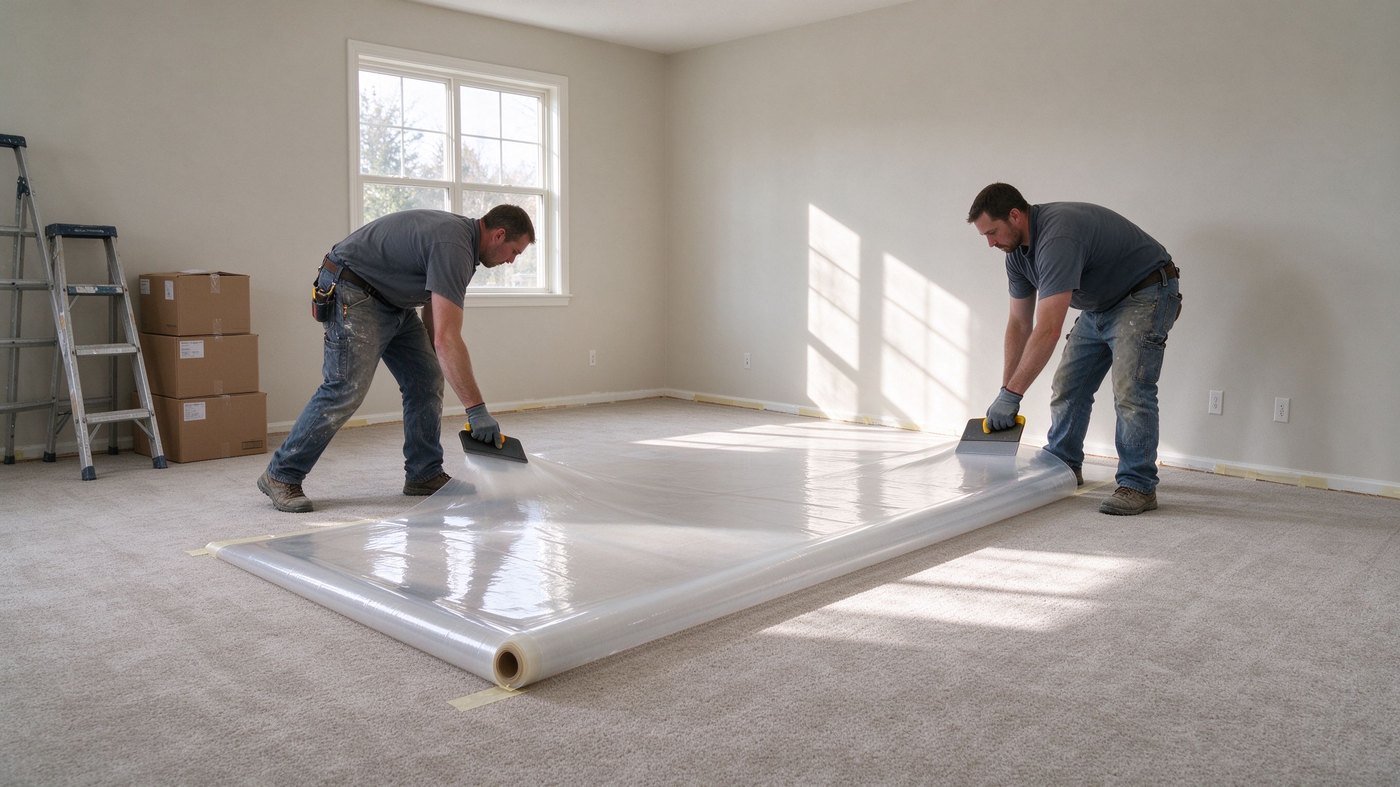
The fix. Vacuum, verify dry (a hand pressed flat for 30 seconds should come up without condensation), bring the roll into the room the night before, and use a squeegee or applicator to drive the film into the pile rather than laying it on top. On dense loop or short Berber, ask for the higher tack grade; on long pile, the lower one.
2. “The edges lift, then the whole sheet walks”
This one barely appears in consumer reviews but dominates site complaints. Industry technical notes describe edge lift and migration as the most frequent carpet-film failure on construction sites, and the causes are specific: insufficient tack for the substrate, application onto a dusty or damp face, low ambient temperature, and a roll too narrow for the traffic pattern crossing it.
Why width matters more than people expect. A 24-inch roll in a corridor with trolleys and boot traffic gets loaded along one edge only. The unsupported side lifts, the lift propagates, and by day three you have a trip hazard and a bare strip of carpet.
The fix.
– Match width to traffic: 36–48 inch in open rooms and corridors, 24 inch for stairs, closets and single-person work.
– Overlap every seam by 50–75 mm and press it down; a butt joint is a built-in lift point.
– Tape the perimeter to the skirting or substrate, never rely on adhesive alone at the boundary.
– Re-check edges at the end of day one. Edge lift caught at 24 hours is a two-minute fix; at day five it is a re-lay.
3. “It’s too sticky to unroll — it grabs itself”
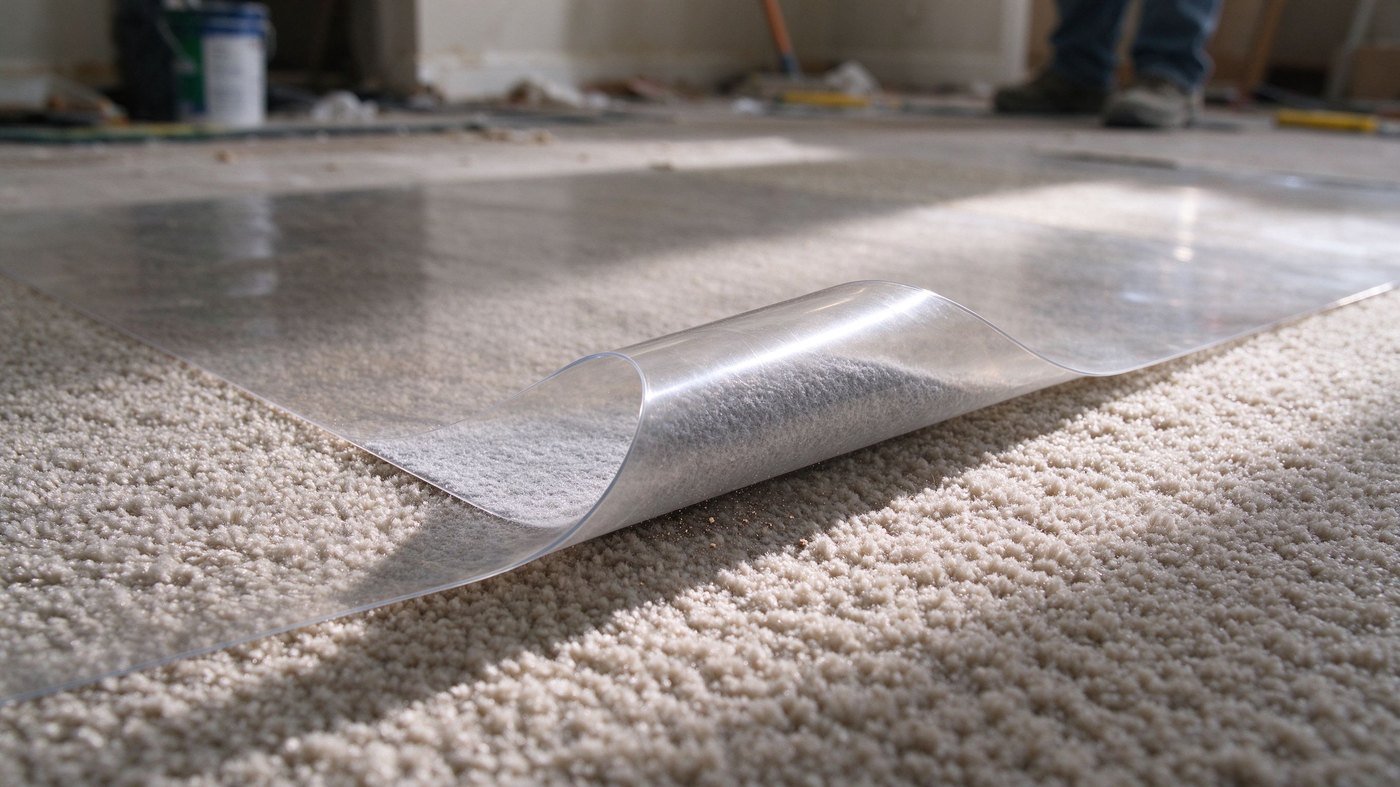
Fully covered in our dedicated article on why carpet film sticks to itself, so just the short version here: this is a product property, not a technique problem. A roll that fights you at the core has blocking between adhesive and backing, uneven unwind tension, or has been compressed in storage. Good film pays out with light, even resistance and does not need two people and a bad temper.
What we do about it. Blocking control and consistent unwind are engineering decisions at the coating line, not something a customer can fix in the field. When a roll misbehaves, we want the lot number, because that tells us which coating run to look at.
4. “It left my carpet sticky — and weeks later it went dark”
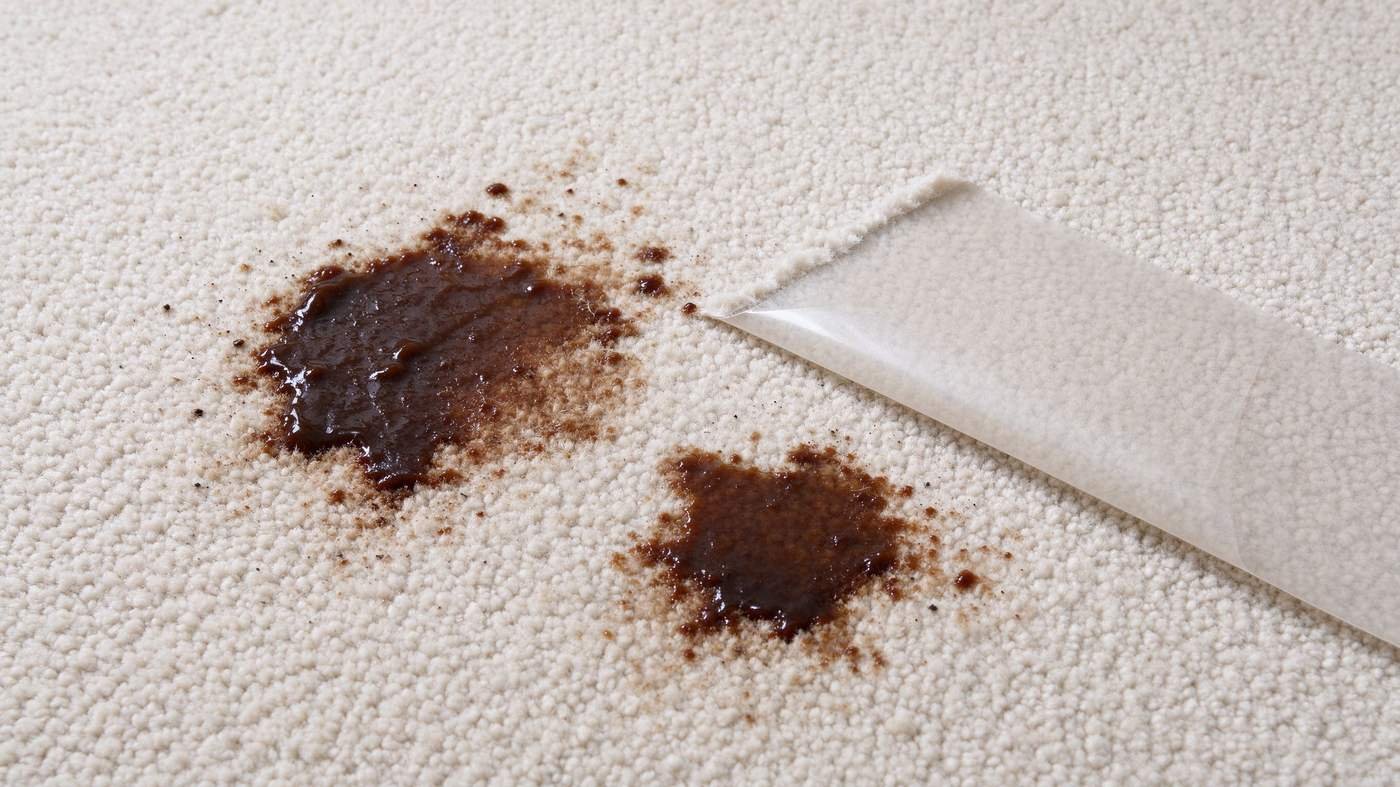
What buyers wrote. Retail review summaries on this product family land on the same three words: sticky residue, hard to apply, poor adhesion. The nasty part is the delay. A carpet-care specialist bulletin describes it precisely: the adhesive is colorless, so residue is invisible at first; months later, soil begins to bond to it and the carpet shows dark patches that look like a stain but are actually glue.
What actually happened. Adhesive transfer has four triggers, and three of them are the installer’s:
- Dwell time overrun. Films are rated 30, 45 or 60 days. The rating is a limit, not a suggestion. (How the two common ratings differ: 30 vs 45 days.)
- Application to damp carpet. The single most common cause we see in claims.
- Heat and direct sun. A south-facing room in summer behaves like a film that has been down twice as long.
- Adhesive architecture. Continuous flat adhesive sinks into the pile and bonds along the fiber length; bead-structured adhesive contacts the pile at points and releases cleanly. This is the one factor the buyer cannot see, which is why asking your supplier what the adhesive structure is matters more than asking for “low tack”.
60-second test. After removal, rub a white cotton cloth hard across one square meter. Any drag or faint sheen means transfer has started. Do it before the cleaner leaves, not three weeks later.
If it has already happened. Do not attack it with solvent. Solvents soften the adhesive and spread it deeper, and they can damage the carpet backing — professional bulletins are explicit about this. Dry-extract first, test any solvent on an offcut or a closet corner, and hand the job to a carpet cleaner who will warrant the result.
5. “It tore the moment I pulled it”
Thin film does not tear because it is cheap; it tears because it is being used as a rope. Pulling a 2 mil film taut across a room and dragging it into place puts all the load on the narrowest point. Add a stair nosing or a furniture leg and you get a run.
The fix is two-part. Choose thickness by job, not by price (2 vs 3 vs 4 mil), and lay rather than pull: unroll two meters, press, step forward, repeat. The hidden cost of a tear is not the wasted film — it is fragments left in the pile that surface weeks later in a client’s carpet.
6. “Bubbles, wrinkles, ridges down the middle”
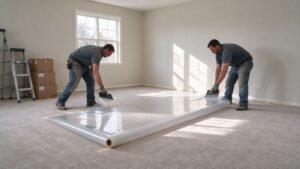
Almost always an application issue with two specific habits: film laid down without a squeegee or hand sweep to expel air, and film re-lifted to “adjust” it. Once adhesive has touched the pile and been pulled back, it has already picked up fiber and dust and will not re-bond properly.
The fix. Work in two-meter passes, sweep from the center outward, never re-lift — cut and overlap instead. Full sequence in our installation walkthrough.
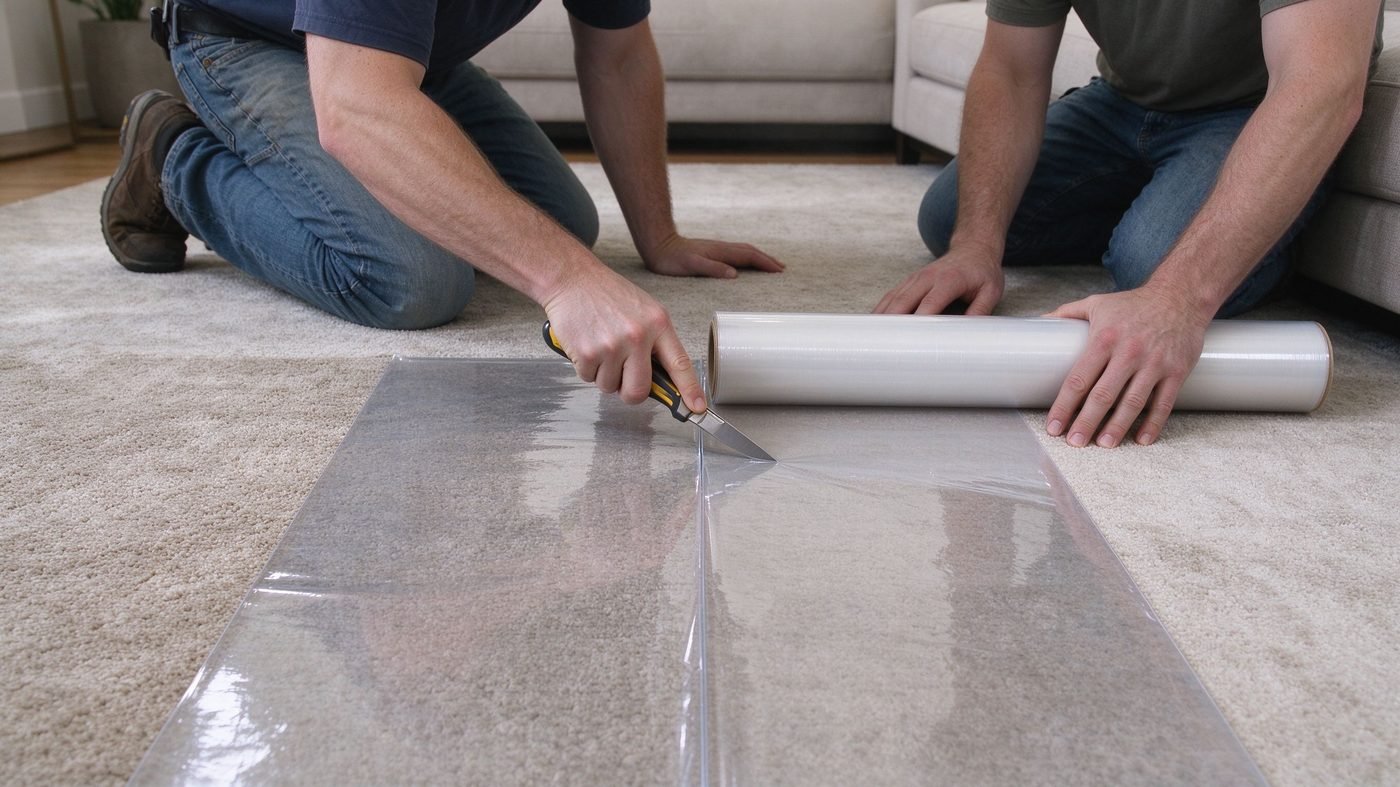
7. “Half the room and the roll was gone”
One review puts it better than we could: “I only wish I bought a second roll, as you will probably need more than you’d expect.” Buyers estimate coverage by looking at a room. Rolls are sold by area.
Run the numbers before you order — our coverage calculator does it in one screen, including the 10% overlap and waste allowance that eyeball estimates always miss.
8. “Removing it was a fight, and it took pile with it”
What buyers wrote. A contractor on a trade forum: “It was too sticky and difficult to get off, especially after being in the sun for a while. It required cleaning.”
Three variables decide whether removal is clean or catastrophic:
- Angle. Pull at 15–30° to the floor, low and slow. Pulling vertically converts peel force into fiber pull.
- Temperature. Under about 15 °C the adhesive is brittle and grabs. Let the room warm up, or use a heat source at a distance — never a hot-air gun held close.
- Dwell. Film past its window has started to transfer and will feel bonded, because in places it is.
60-second test before you commit to a full peel. Lift a 30 cm corner at a low angle. If it releases with a soft zip, proceed. If it takes steady force and you hear fibers, stop and warm the room first.
9. “It ruined a wool carpet / a brand-new carpet / a sunny room”
This is the complaint where the honest answer is: the product should not have been sold for that job. The documented exclusions are consistent across manufacturers and carpet-care specialists:
- Wool and other natural fibers — surface fibers can lift or fuzz; only use where the film maker explicitly permits it.
- Newly installed carpet — wait until the installation adhesive has cured, commonly 72 hours.
- Wet or damp carpet — never.
- Direct sun and high heat — the removal window shortens sharply.
- Hard floors — carpet film on tile, vinyl or wood is the wrong product entirely (see film vs masking tape for the floor-protection decision).
A supplier who will not tell you where not to use the film is telling you something about the supplier.
10. The three-minute field diagnosis
When a job goes wrong on site, run this before you call anyone:
- Is the film off the pile, or bonded and grabbing? Off = surface condition or tack grade. Bonded = dwell, heat, or moisture.
- Did it fail at the edge or in the middle? Edge = width, traffic, perimeter taping. Middle = application sweep or film tension.
- Did it fail in the first hour or after a week? First hour = cold room, dust, damp, wrong grade. After a week = traffic, sun, dwell.
- Is there fiber on the adhesive when you lift it? Yes = the film is working and the peel technique is wrong. No = the film never bonded.
Four questions, and you know whether to send a person or a roll.
11. If you distribute this product: what to record
Complaint triage is only possible with data. For every failed job, capture:
- lot or batch number from the core
- date applied and date removed (against the rated window)
- carpet type and pile structure
- ambient temperature at application and at removal
- photos: edge lift, residue swab, and the roll label
Without the lot number and the two dates, every complaint becomes a story and no supplier can trace it. This is why we print an install-date box on the core: it turns an argument into a record.
12. What we changed because of these complaints
None of the nine complaints is new to us. Each one maps to a decision on the coating line or on the label:
- Blocking and unwind control so a roll pays out without grabbing itself — complaint 3.
- Tack graded to pile type rather than one grade for all carpet — complaints 1, 2 and 9.
- Adhesive structure chosen for clean release, not maximum grip — complaint 4.
- Width matrix (narrow for stairs, wide for open floors) instead of a single stock width — complaint 2.
- Rated window and install-date box printed on the core — complaints 4, 8 and 11.
- A written exclusion list on the spec sheet, because complaint 9 is a specification failure, not a manufacturing one.
FAQ
Why did my carpet film not stick at all?
Nine times in ten the surface is the cause: dust, residual moisture from cleaning, or a room below about 15 °C. Vacuum, verify the carpet is dry, let the roll reach room temperature, and press the film into the pile with a squeegee before blaming the adhesive.
Can I use carpet protection film on a wool carpet?
Only if the film manufacturer explicitly permits natural fibers. On wool and wool-blend carpet, surface fibers can lift on removal. A taped drop cloth attached to the skirting avoids the risk entirely.
How soon can film go down on new carpet?
Wait until the installation adhesive has cured — commonly 72 hours — and until the carpet is fully dry.
What does sticky residue on carpet look like?
At first, nothing: the adhesive is colorless. Weeks later, soil bonds to it and appears as dark patches. Rub a white cloth over the area right after removal; any drag means transfer has started.
Is it normal for the edges to lift after a day?
No, and it is fixable. Edge lift means tack is too low for the traffic, the roll is too narrow for the walkway, or the perimeter was never taped. Re-press and tape the edges within the first 24 hours.
How do I remove film that feels glued down?
Warm the room to at least 15 °C and peel low and slow at a 15–30° angle in short pulls. Never pull vertically; that is how pile gets pulled out.
Get the grade matched to your job
Tell us the carpet type, the area, and how long the film has to stay down, and we will match tack grade, thickness and width — and tell you if film is the wrong tool for that room.
Request a quote and samples · See carpet protection film specifications
¿Prefiere leerlo en español? Este diagnóstico está disponible como diagnóstico de nueve quejas reales en español.