The coverage formula
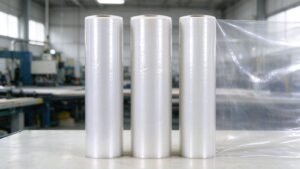
Carpet protection film is sold by the roll in a width and a length. A roll’s coverage in square feet is simply:
Roll coverage (sq ft) = Width (ft) x Length (ft)
Convert inches to feet by dividing by 12. Then:
Rolls needed = Total area ÷ Roll coverage x Waste factor
The waste factor accounts for cuts, overlaps, doorways, and mistakes. Plan on 1.10 to 1.15 (10-15% extra).
Example: 1,000 sq ft with common roll sizes
| Roll size (width x length) | Width in ft | Coverage per roll | Rolls for 1,000 sq ft (incl. 15% waste) |
|---|---|---|---|
| 24 in x 50 ft | 2.0 ft | 100 sq ft | ~12 rolls |
| 36 in x 100 ft | 3.0 ft | 300 sq ft | ~4 rolls |
| 38 in x 100 ft | 3.17 ft | ~317 sq ft | ~4 rolls |
| 48 in x 100 ft | 4.0 ft | 400 sq ft | ~3 rolls |
These are planning estimates. Confirm the exact width and length of the SKU you order, because coverage changes with every roll dimension. Use our coverage calculator for a project-specific number (the interactive tool is being rolled out; in the meantime the formula above works).
Worked example
A contractor needs to protect 1,000 sq ft of carpet. They use 38 in x 100 ft rolls.
- Width in feet: 38 ÷ 12 = 3.17 ft
- Coverage per roll: 3.17 x 100 = 317 sq ft
- Rolls without waste: 1,000 ÷ 317 = 3.15 rolls
- With 15% waste: 3.15 x 1.15 = 3.62 rolls
- Round up: 4 rolls
How to reduce waste
Measure first, apply second
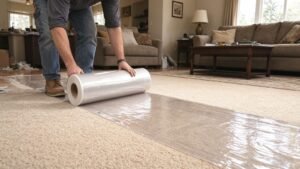
Walk the space and map the long runs. Film is applied in strips along the longest dimension of each room; planning the strip layout before unrolling reduces cut-off ends.
Overlap, don’t gap
A 1-2 inch overlap between strips is normal and counts toward coverage. Do not leave gaps, but do not overlap aggressively — every extra inch of overlap is coverage you are paying twice for.
Keep a roll per worker
Handing each crew member a dedicated roll stops un-rolled strips from being walked on and wasted mid-job.
How to estimate irregular rooms
For L-shaped or furnished rooms, break the space into rectangles, calculate each rectangle’s area, and add them. Do not guess by walking the space with your foot — that consistently undercounts by 10-15%. If the room has large fixed furniture that will not move, protect the open walkways first and skip the under-furniture areas; that cuts coverage without compromising protection.
Frequently asked questions
How many square feet does a 38 in x 100 ft roll cover?
About 317 sq ft. Calculate it as (38 ÷ 12) x 100. Add 10-15% waste when ordering for a real job.
Should I buy extra rolls or stick to the math?
Always round up. A half-used roll on a shelf is cheap insurance; running out on a Friday afternoon costs a day of labor. The waste factor already covers most surprises.
Does carpet pile depth change coverage?
No. Coverage is a floor-area calculation; pile depth affects adhesion and application feel, not how many square feet a roll covers.
What roll size is most cost-effective?
Wider rolls (36-48 in) cover more floor per linear foot and usually cost less per square foot. Use them on open floor areas; use narrower 24 in rolls for stairs and tight corridors where wide film overhangs.
Where do I find exact roll dimensions?
Width and length are listed on the carpet and floor protective film page. For custom roll lengths or private-label sizes, see the manufacturer guide and the FAQ. Need a project quote? contact our factory with your area and roll preference.
Running a larger commercial job? Pair this calculator with the coverage calculator tool (coming soon) and ask for a bulk sample to confirm roll dimensions before ordering.
Related Applications
See how these films are used in real production and renovation settings: