How long can carpet protection film stay on before it must come up?
Carpet protection film is a temporary sacrificial layer, not a permanent floor covering. Every film on the market is built around a rated removal window — the period during which the manufacturer guarantees the film will peel away cleanly without leaving adhesive residue or pulling carpet fibers. For most general-purpose products that window is 30 days. For heavy-duty, UV-stabilized grades it can reach 45 days. Some ultra-premium contractors’ films claim longer, but those numbers are always tied to specific test conditions.
Why the window is not infinite
The adhesive on carpet film is designed to start releasing its grip over time. That release is what makes peeling easy. But the same chemistry, combined with heat, sunlight, and foot traffic, eventually crosses a line: the adhesive oxidizes, migrates into the carpet backing, and becomes harder to remove rather than easier. That crossing point is the rated end-of-life.
30 days vs 45 days: what actually changes
| Factor | 30-Day Film | 45-Day Film |
|---|---|---|
| Typical use case | Standard renovation, staging, short construction | Longer commercial projects, summer jobs, sunlit rooms |
| Adhesive system | Standard removable acrylic | Enhanced, UV-resistant acrylic (confirm on spec sheet) |
| Best applied temperature | Per manufacturer guidance (confirm with our factory) | Same — warmer surfaces activate adhesion |
| Residue risk after window | Rises sharply past day 30 | Rises sharply past day 45 |
| Best for | Budget-conscious, predictable schedules | Projects with uncertain timelines, exposure to light |
What happens if you leave it on too long?
The failure mode is consistent across suppliers: the film does not fail by breaking down, it fails by bonding harder. Heat from sunlight through windows, combined with the adhesive’s natural aging, causes the glue to migrate. Symptoms you will see:
- The film stretches instead of peeling when you lift an edge.
- Adhesive transfers to the carpet backing when the film finally comes off.
- The film yellows and becomes brittle.
- Residue requires solvent cleaning and, in bad cases, professional carpet work.
This is why the day rating matters — it is not an arbitrary number, it is the last date you can peel without expecting cleanup.
Contractor best practices
How to decide between 30-day and 45-day film
Choose 30-day film when the project has a fixed, short schedule and the space is not heavily sunlit. Choose 45-day film when timelines slip, the job runs through summer, or large windows expose the film to direct UV. When in doubt, a longer-rated film costs marginally more and removes the schedule risk entirely.
How to peel it up cleanly
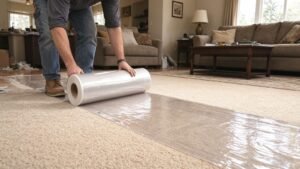
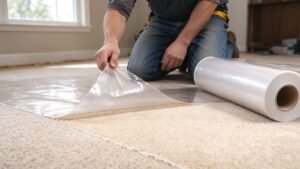
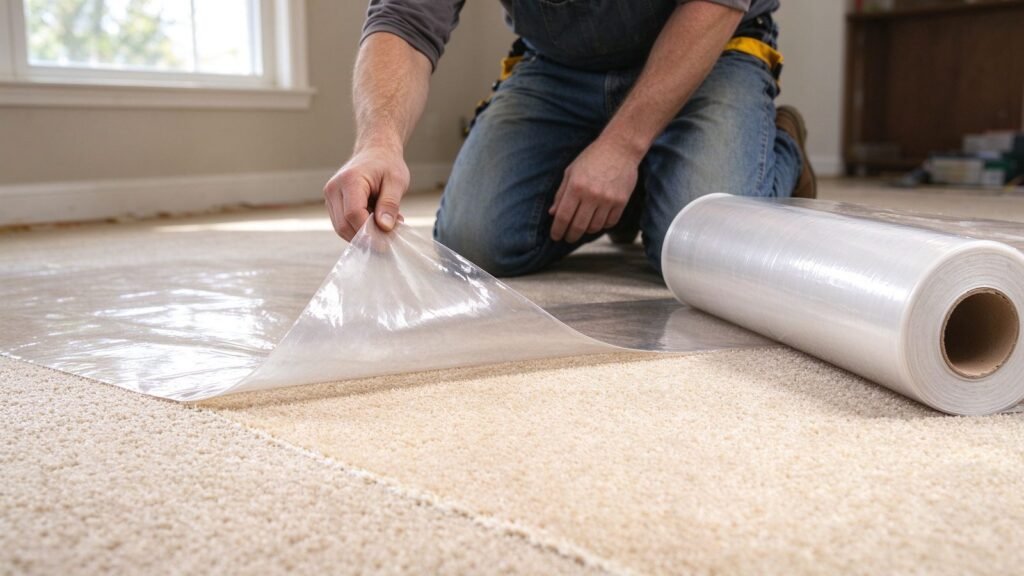
- Lift a corner at a 45-degree angle, not straight up.
- Pull slowly toward you; fast pulls stretch the film.
- Warm the surface in cool weather if adhesion feels stiff.
- Document the application date on the roll label so the removal date is unambiguous.
Is the day rating a guarantee?
The rated window is a tested reference, not a promise under every condition. Real-world variables — room temperature, direct sun, carpet fiber type, and foot traffic — shift the actual safe window. Treat the rating as the planning target, and peel slightly early rather than late. Always confirm the specific day rating for the exact SKU on your spec sheet, as different adhesives behave differently.
Frequently asked questions
Can I leave carpet protection film on for 2 months?
Not if it is rated for 30 or 45 days. Two months is well past the removal window for standard film. Expect adhesive transfer and residue. If your project genuinely runs that long, schedule a re-application: peel the old film, clean the carpet, and apply fresh film rather than overextending one roll.
Why did my carpet film leave sticky residue?
Almost always because the film was left past its rated removal window, because it was applied to a hot or contaminated surface, or because the adhesive formulation was not matched to the carpet fiber type. Residue after day 30 on a 30-day film is the expected outcome, not a defect.
Does UV exposure shorten the removal window?
Yes. Direct sunlight heats the film and accelerates adhesive aging. A room with strong south-facing windows may see the effective window shortened. This is exactly where a 45-day UV-stabilized film earns its cost premium.
How do I know if my film is 30-day or 45-day rated?
Check the product spec sheet or the roll label. The day rating is always printed there. If you are comparing carpet and floor protective film from different suppliers, the adhesive system and day rating are the two numbers to match. Need a confirmed spec? Contact our factory for the exact SKU rating.
Should I remove film before a final clean or after?
Remove the protection film, then do the final carpet clean. The film is meant to come off while the carpet is still construction-dirty; peeling after a deep clean risks trapping fine debris under the film edge.
Planning a multi-room job? See our carpet protection film manufacturer guide and our FAQ for more technical answers. Request a sample roll to test peel behavior on your own carpet before committing to a full order.
Related Applications
See how these films are used in real production and renovation settings: