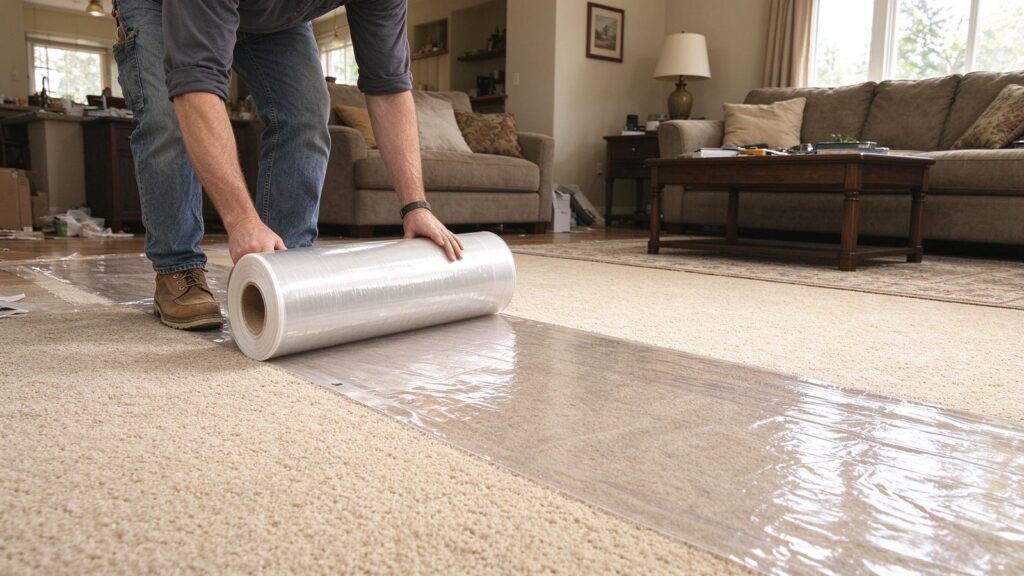
What does “sticking to itself” actually mean?
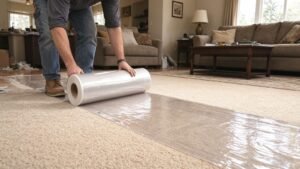
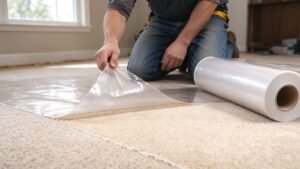
Carpet protection film is wound onto a roll with the adhesive side against the back of the next layer. When you unroll it, the adhesive should release cleanly from the back surface. If instead the back surface is tacky or has no release treatment, the adhesive grabs it, and the film resists unrolling, stretches, or tears. That is the self-sticking problem.
It is not the same as the carpet adhesion
The adhesive’s job is to stick to the carpet. The back surface’s job is to NOT stick to anything. When the back surface fails, the roll fights you while you apply it — even if the carpet bond is perfect.
Why it happens
| Cause | What goes wrong | How to spot it |
|---|---|---|
| No anti-blocking layer | Back surface is bare PE, which is naturally tacky when wound tight | Film unrolls in jerks, snaps back |
| Co-extrusion missing | Cheap mono-layer film has no separate release skin | Whole roll feels sticky on the back |
| Hot storage / transport | Heat softens PE and drives adhesive into the back | Roll arrives stuck together after a summer shipment |
| Over-wound roll tension | Tight winding presses layers together over time | Older rolls are worse than fresh ones |
| Adhesive coat too heavy | Glue bleeds through to the back over the roll’s shelf life | Adhesive residue visible on the back liner |
How manufacturers solve it
Anti-blocking treatment
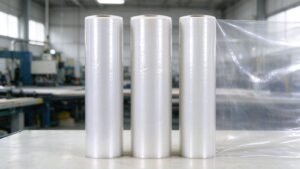
Reputable carpet film uses a co-extruded structure: a core layer, an adhesive layer on the carpet side, and a release (anti-block) layer on the back. The release layer is formulated so the adhesive does not grab it. This is the main reason two films with the same mil rating can feel completely different on the roll.
What to ask your supplier
- Is the film co-extruded or mono-layer?
- What is the back-surface treatment (anti-block additive type)?
- What is the recommended storage temperature range?
- How long is the shelf life of a roll before winding pressure starts to bite?
These are engineering questions, not marketing questions. A supplier who cannot answer them is supplying commodity film.
Field fixes when a roll is already sticky
During application
- Let the roll acclimate to room temperature before unrolling (do not apply cold film).
- Unroll slowly and in short sections — do not pull a long strip at once.
- If the roll snaps back, pause and let it relax rather than fighting it.
- Keep the roll out of direct sun and off hot radiators or van dashboards.
Storage best practice
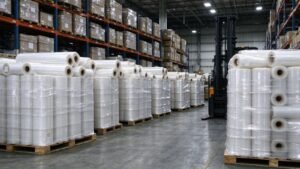
Store rolls flat, not on end, in a cool dry area. A roll that has been in a hot delivery van for two days is the most likely to self-stick. If the film is stuck on arrival, contact the supplier before the job — heat-damaged rolls should be replaced, not fought through.
Frequently asked questions
Is self-sticking a sign of a bad batch?
Sometimes. If every roll in a shipment is sticky, it is likely heat damage in transit or an under-treated release layer. If only old rolls are sticky, it is winding pressure plus age. Either way, the symptom is worth reporting to the supplier.
Can I use talcum powder to stop it sticking?
Do not. Powder contaminates both the adhesive and the carpet. The correct fix is a properly treated film, not a field workaround.
Does thicker film stick to itself less?
Thicker film is stiffer, which reduces how readily layers conform and bond, but the release layer is the real fix. A thin co-extruded film unrolls cleaner than a thick mono-layer film.
Why does it stick in summer but not winter?
Heat softens polyethylene and lowers the tack temperature threshold of the adhesive. A roll that behaves at 20°C can self-bond at 40°C in a delivery van. Storage temperature is the single biggest controllable factor.
Where can I get film with a proper release layer?
Look at the carpet and floor protective film spec for the co-extruded structure, and read the manufacturer guide. If you are comparing suppliers, the release-layer treatment is the line item to ask about. Open questions in the FAQ or contact our factory directly.
Testing a new supplier? Request sample rolls and unroll them in your own conditions before placing a bulk order. The roll feel is the first thing you will notice — and the first thing you should judge.
Related Applications
See how these films are used in real production and renovation settings: