TL;DR — What buyers need to know. The biggest risk in protective film sourcing is not the first sample — it is batch-to-batch consistency. A perfect first roll means nothing if the tenth container arrives with 20% higher peel strength, 10% light gauge, or adhesive that smears. The way serious buyers protect themselves is a 9-point incoming QC checklist, agreed in writing with the supplier before the first order. This is the checklist used by buyers who audit protective film factories.
Why Batch-to-Batch Consistency Matters More Than the First Sample
Factories can make one excellent roll. They cannot make ten thousand identical rolls without process control. Resin lot changes, adhesive coat-weight drift, extruder temperature variation, and slitting tension all move the finished spec between runs. Buyers who only approve the first sample are surprised six months later when a re-order leaves residue on a customer’s parts. The fix is not a different factory — it is a written QC protocol with measured tolerances on every critical parameter.
The 9-Point Incoming QC Checklist
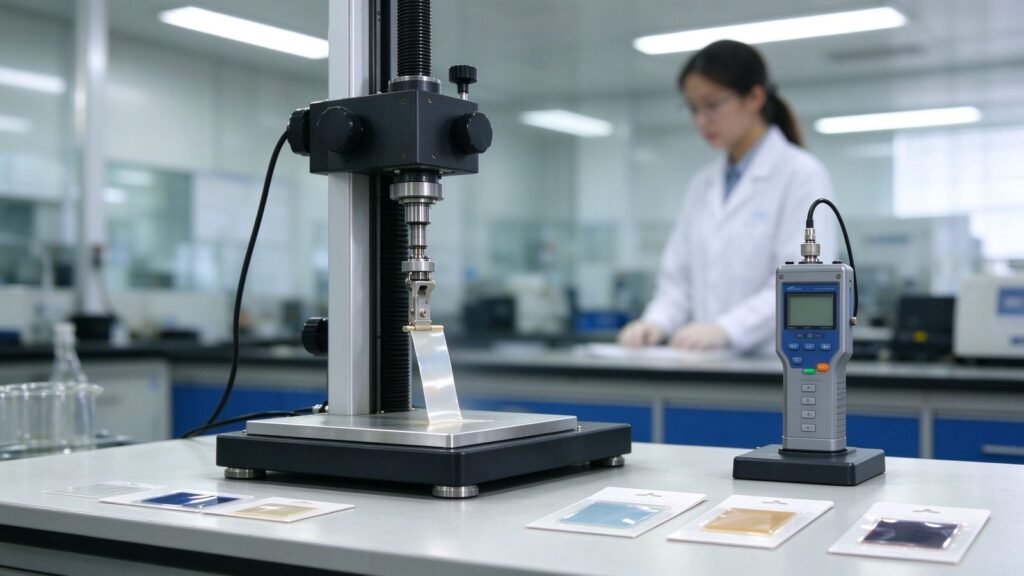
Use this table as a starting checklist. Tolerance values are typical industry reference ranges; agree the exact tolerances with your supplier in writing before mass production.
| # | Check | Method / Tool | What It Catches |
|---|---|---|---|
| 1 | Gauge (thickness) across the web | Digital micrometer, 3 points across width | Light or heavy rolls; ±10% typical tolerance |
| 2 | Width and length | Tape measure, roll weighing for length | Short-length rolls, slit-to-wrong width |
| 3 | Peel adhesion (day 1) | 180° peel test on your own substrate, ASTM D3330 method | Over-tacked or under-tacked batches |
| 4 | Aged peel adhesion | Peel after 7-day or 30-day dwell, per spec | Batches that will leave residue after storage |
| 5 | Visual surface defects | Visual inspection on a light table: fish eyes, gel particles, scratches | Poor resin filtration, die build-up |
| 6 | Adhesive transfer / residue check | Peel and inspect substrate after forced aging | Incompatible adhesive, under-cured coating interaction |
| 7 | Roll wind quality | Visual: telescoping, wrinkles, edge lift | Slitting tension problems |
| 8 | Color / clarity / haze | Visual compare to approved standard, haze meter if optical | Resin lot change, off-spec masterbatch |
| 9 | Certificate of Analysis (CoA) review | Match batch number on CoA to roll label | Mismatched documentation, swapped rolls |
Note: specific tolerance numbers (±g/25 mm, ±µm, % allowed defects) are intentionally not fixed here. They are negotiated per application. A buyer of optical acrylic film needs tighter tolerance than a buyer of construction film. See also common quality problems of PE protective film.
What to Ask for Before the First Order
Before you place mass production, ask the supplier for four documents in writing: (1) the spec sheet with target values and tolerances, (2) a sample CoA from a previous batch, (3) the test method for each critical parameter (so you can replicate it in your own QC lab), and (4) the rejected-rate history (internal first-pass yield). A supplier who hesitates on any of these is not ready for volume orders. Factories with ISO 9001 and regular customer audits — like ours — publish these routinely.
What to Do When a Fails a QC Check
Do not negotiate verbally. Pull three sample rolls from the disputed lot, photograph the defect, run the same peel and gauge tests, and send the evidence with the batch number. Ask for: root cause, containment for the remaining lot, corrective action, and a replacement shipment. Repetitive failures on the same parameter mean the supplier cannot control that process — switch the grade or the factory. More QC and audit questions on our FAQ page.
Related Buying Guides
- Quality Problems of PE Protective Film
- Causes of Quality Defects in Film Slitting
- How to Choose a Reliable Protective Film Manufacturer in China
- Contact Us for Sample and CoA
FAQ: Batch-to-Batch Consistency and QC
How many samples should I pull from each incoming roll?
At minimum three points across the web for gauge, and one peel test on your own substrate. For first orders and new suppliers, increase sampling to every roll; after six consistent batches, move to AQL-based sampling.
What is a CoA and why does it matter?
A Certificate of Analysis is the supplier’s test record for a specific batch, listing gauge, peel strength, and appearance values. Match the CoA batch number to the roll label. A supplier who cannot provide a CoA per batch cannot prove consistency.
What is a typical acceptable tolerance for peel strength?
Industry reference is typically within ±10–20% of target, but the exact tolerance is negotiated per application. Optical and sensitive substrates need tighter tolerance than rough construction film. Agree it in writing before mass production.
How do I audit a protective film factory before ordering?
Ask for: spec sheet with tolerances, sample CoA, test methods for each parameter, first-pass yield history, and ISO 9001 certification. Buyers with volume orders should also request a video audit or third-party inspection report.
How do I request a CoA and sample roll for audit?
Use our contact page. Tell us your substrate and the grade you are evaluating — we will send a sample roll, the spec sheet, and a previous batch CoA for your own QC lab.
Related Applications
See how these films are used in real production and renovation settings: