Seven Aluminum Protection Film Failures: Coating Pull-Off, Black Corrosion, and What Actually Caused Them
Aluminum is the material where a protection film is most likely to be blamed for something it did not do — and most likely to actually cause something nobody checked for. The substrate is light, the coatings are thin, the profiles get handled four or five times before they reach site, and the whole supply chain assumes a white or blue film is a neutral object that cannot interact with what is under it.
It can. The seven failures below are the ones we get asked about most often from profile extruders, façade fabricators, ACP (aluminum composite panel) converters and installers. For each one, the pattern is the same: a visible symptom, a physical cause that is usually one step upstream, a question of who pays, and a check you can run in a minute before the container ships.
If you are still choosing between anodized, powder-coated and brushed surfaces, or between tack levels and roll widths, that belongs in our guide to choosing protective film for aluminum profiles. This article is the other half: what goes wrong after the film is already on the metal.
The one thing that makes aluminum different from steel
Steel arrives at the film as a single surface. Aluminum usually arrives as a two-layer system: a substrate, plus an anodic layer, a powder coat, a fluorocarbon finish, or a coil-applied paint system. The film never touches the aluminum. It touches the coating, and the coating’s own adhesion to the substrate becomes the weakest link in the whole stack.
That single fact explains most of the surprises:
- Peel force adds up. A film specified to hold onto a mill finish will hold onto a powder coat too — and if the coating bond is marginal, the film wins the argument and takes paint with it.
- Aluminum’s oxide layer is self-healing but not self-cleaning. Freshly exposed aluminum re-oxidizes instantly, which is protective. But under a film, moisture and chloride have nowhere to escape, and the same oxide chemistry that protects in air can turn into localized pitting in a trapped film pocket.
- The surfaces are directional. Anodized and brushed aluminum reflect and scatter light along a grain; a residue layer or a wrinkle that would be invisible on 2B stainless becomes an obvious band or rectangle on anodized.
- Coil-coated sheet is wound under tension. ACP and coated coil get film applied at line speed and then wound onto themselves. Whatever the film does under tension and pressure it does to thousands of square meters at once.
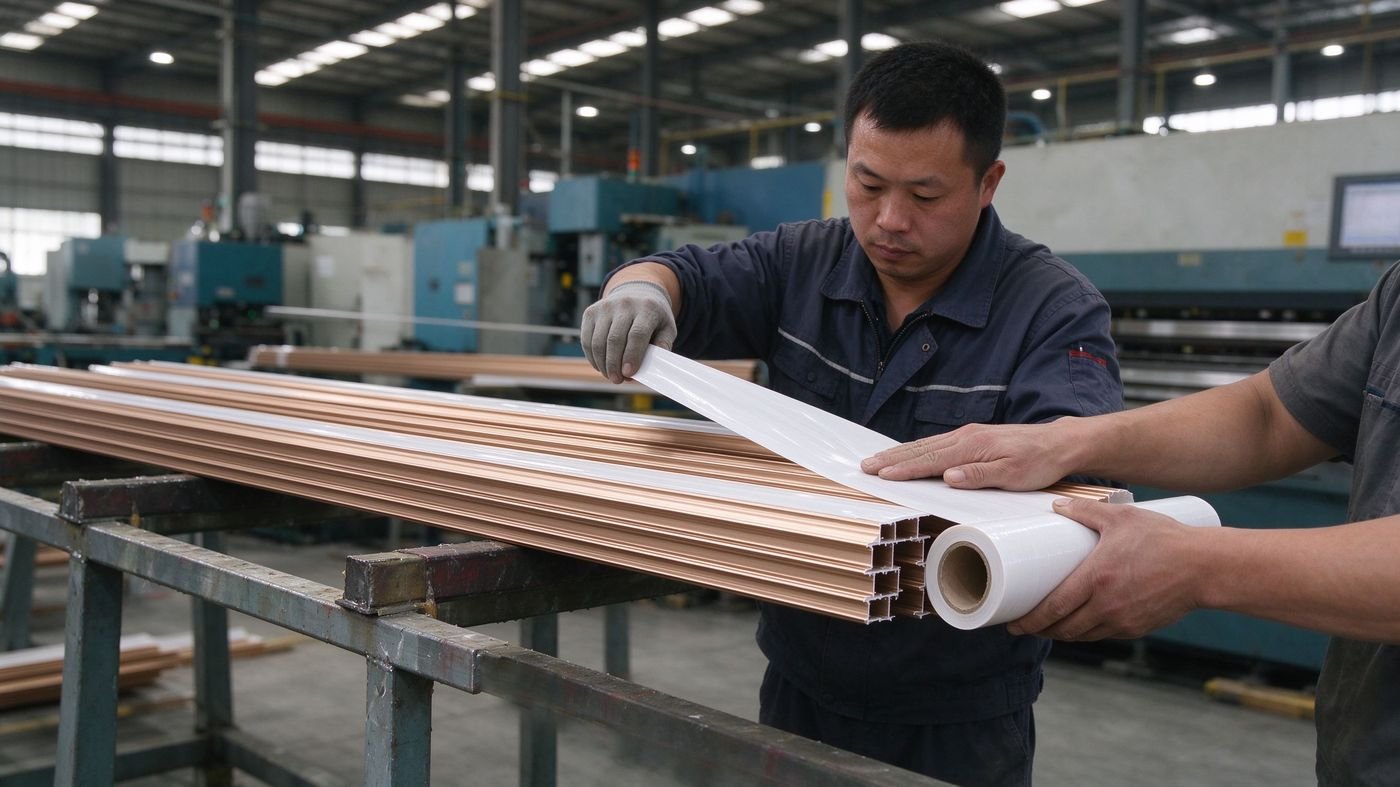
Failure 1: The film takes the coating with it
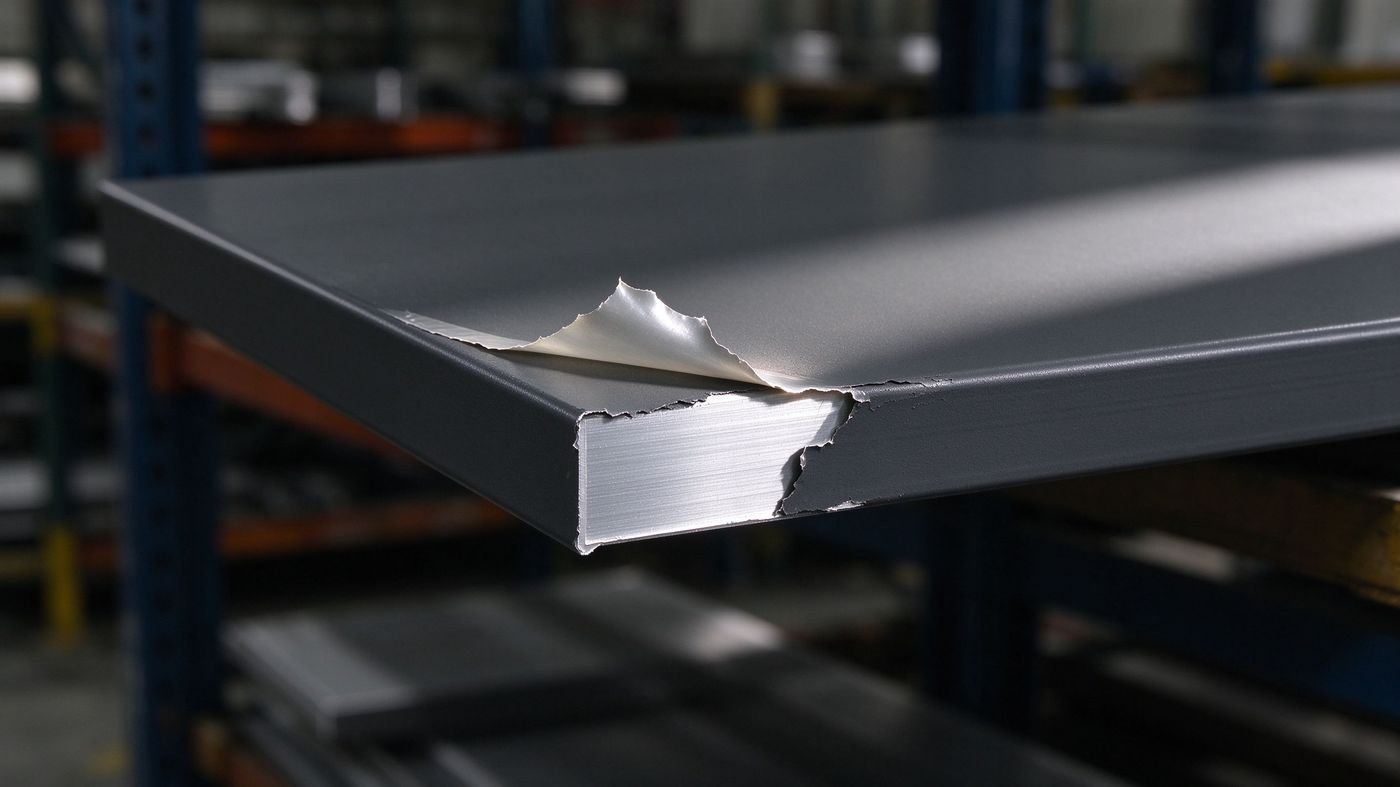
Symptom. The film comes off and leaves bare silver metal in a patch, usually near an edge or a corner. The paint line around the patch is ragged, feathered or lifted, not clean. Sometimes the coating comes away in a sheet as large as the film itself; sometimes it is a narrow fringe along the cut edge that nobody notices until the panel is already on the façade.
What actually happened. Two different bonds were compared and the weaker one lost. The film’s adhesive had more peel strength than the coating had adhesion to the aluminum. That imbalance can come from any of five directions, and in practice it is usually a combination:
- The coating was under-cured or over-cured. Under-cured powder coat is soft and cohesive-failure prone; over-cured coat is brittle and releases in flakes. Both look fine to the eye and both fail under a peel.
- The surface was contaminated before coating, not before filming. Release agent, handling oil, or a skipped pretreatment stage leaves a boundary layer the coating sits on top of rather than bonds to. The film then does the test that nobody ran at coating time.
- The film’s tack was specified for mill finish. Mill, anodized and coated surfaces need different adhesion. Using a high-tack film across all three is the most common single cause we see.
- The peel was done wrong. Pulling at 90° and fast concentrates stress at the bond line. A film that releases cleanly at a shallow angle and slow speed can strip coating when yanked perpendicular.
- Temperature at removal. Peeling cold-coated panels in a cold workshop raises adhesive stiffness and peel force at exactly the moment the coating is least flexible.
Who owns it. Not the film supplier, unless the film was specified as suitable for a coating type it was never tested against. The responsibility usually splits: the coater owns the coating bond, the fabricator owns the application and removal method, and the film supplier owns whether the adhesion it sold is appropriate for that coating. Ask all three for data before the claim meeting, not during it.
The check. Take a coated offcut — the same coating, same cure, same day if possible — apply film, wait the shortest interval you would ever ship at, and peel at a shallow angle by hand. Look at what is on the back of the film: adhesive residue is a film problem, coating flakes are a coating problem, and a mix means both. Do it before you run the full order, not after the first complaint.
Failure 2: Black spots and white bloom under the film
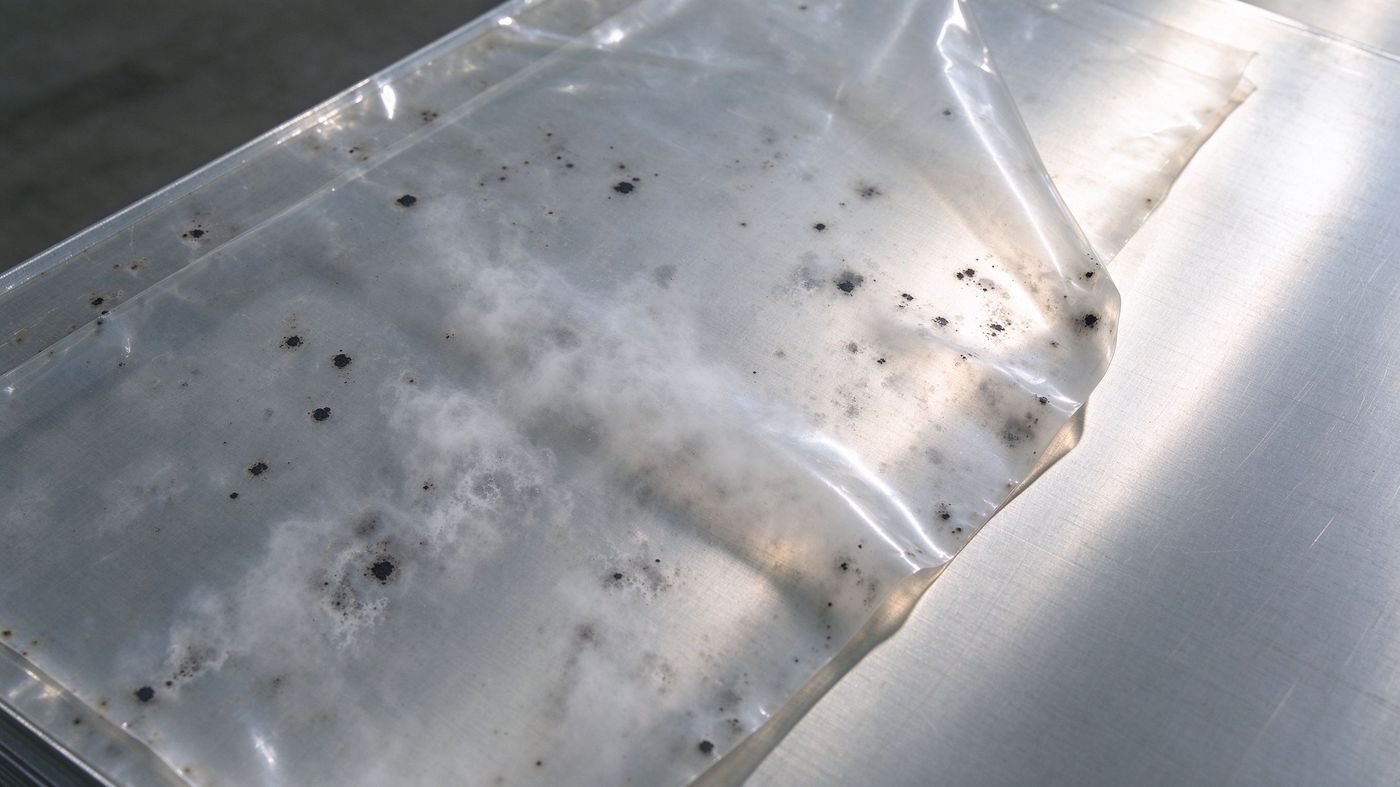
Symptom. After weeks in a container, a warehouse or a site store, the aluminum shows dark pinhead spots, grey-black patches, or a milky white haze. It is always worst along film edges, under wrinkles and under the parts of the film that were never really pressed down. The pattern follows the film, not the metal — which is the first clue that the film is involved.
What actually happened. Water got in, and it could not get out. A film that is not fully in contact creates capillary channels along every wrinkle and every lifted edge. Condensation inside a container, rain during transit, or humid air in an unventilated store puts a thin water film in those channels, and the water carries whatever was on the surface: chloride from handling, acid or alkaline cleaner residue, dust, or salts from a coastal site.
On aluminum, that pocket becomes an electrochemical cell. The oxide layer breaks down locally, aluminum dissolves, and the corrosion product stains dark or blooms white depending on chemistry and alloy. This is not the same failure as rust on steel, and the usual rust advice does not apply: a protective film is not a corrosion barrier in the way a coating is, and a film that traps water can make localized attack worse than no film at all in the same conditions.
- Alkaline residue is the classic accelerator. Aluminum is amphoteric. Alkaline cleaners etch it, and any residue left before filming keeps working under the film.
- Chlorides do the localizing. Fingerprints, dusty gloves, sea air, or wash water that was not fully rinsed concentrate at pinholes and start pitting.
- Temperature swings do the pumping. Daily condensation cycles move water into the channels and concentrate the salts as it evaporates.
- Film edges are the entry point. A film that is not sealed at the edge, or that lifts in transit, gives water a direct route under the whole sheet.
Who owns it. Shared, and the split is decided by evidence, not by argument. If the metal went in clean and dry and the film was applied with good contact, the storage and transport conditions own it. If the metal went in with residue, the cleaning stage owns it. If the film went on wet, the applicator owns it. What the film supplier owes is an honest statement about what its product does and does not protect against in humid storage — a film sold as corrosion protection is being oversold.
The check. Wipe a small area with a clean white cloth and a neutral cleaner before filming. If the cloth comes away grey or soapy, the surface is not ready. After filming, run a thumb across the sheet: any wrinkle or bubble you can feel is a channel. For a shipment going into long humid storage, put one filmed offcut in the worst conditions you expect and inspect it at the interval you actually ship at — that test costs one panel and settles the argument.
Failure 3: Rib lines and wrinkle marks on coil-coated sheet
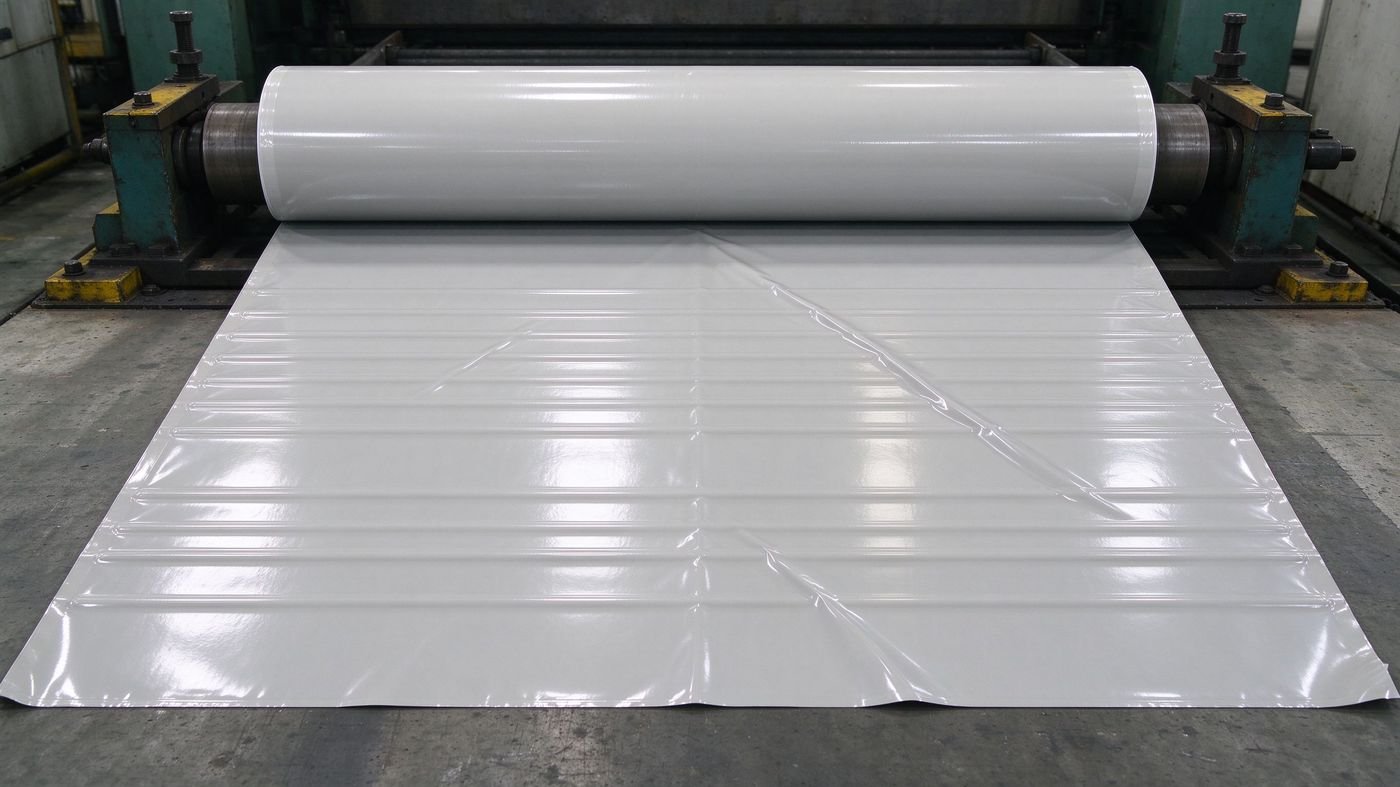
Symptom. After unwinding, the coated aluminum shows evenly spaced transverse lines, a corrugated “rib” pattern, or long diagonal creases. On ACP the same thing shows up as a shadow band across the panel face. Removing the film does not remove the mark; sometimes it gets more visible because the film was masking it.
What actually happened. The film was wound onto the coil under tension that was uneven across the width or inconsistent along the length. Every place where the film was stretched, doubled over, or pressed harder became a line of higher pressure. Coil-coated paint systems are viscoelastic: under sustained pressure, especially warm, they take a permanent set. The film then acts as a pressure-transfer medium, recording the winding pattern into the finish.
- Tension too high at the start of a roll and too low at the end — the classic taper-tension mistake — compresses the first hundreds of meters and leaves the rest slack and wrinkled.
- Wrinkles are not cosmetic. A wrinkle is a fold of film with two layers of adhesive and backing pressing on one line of paint. That is a much higher local load than the surrounding area.
- Warm coils mark more than cold ones. Film applied to a coil that is still warm from the coating line, or stored in sun, softens and conforms into the surface.
- Rewinding without a slip layer doubles the pressure on the same lines every time the coil is handled.
Who owns it. The converting line. This is a winding and tension failure, not an adhesive failure, and the film only reports it. But the film’s thickness and stiffness decide how forgiving the winding is: a very thin film wrinkles easily, a very stiff one transfers pressure sharply. If you are being told “the film is too thin” or “the film is too thick” as a complete explanation, ask what the tension profile was.
The check. Unwind a few meters at production speed and look at the film surface under raking light before you look at the paint. If the film itself is wrinkled, the mark is already being made. Then check whether the lines are evenly spaced — even spacing means tension, uneven and clustered means handling and folds.
Failure 4: Ghost shading on anodized surfaces before sealing
Symptom. A rectangle, a band or a set of streaks that is slightly lighter, darker or duller than the surrounding anodized surface. It is only visible at certain angles, often not at all under diffuse office light, and very obvious when the panel is installed on a façade and seen at a glancing angle in sunlight. Customers describe it as “the film left its shape on the metal”.
What actually happened. Anodized aluminum is a porous oxide that is sealed at the end of the process. Anything that occupies those pores before sealing changes how they seal and how they scatter light. Film applied to an unsealed or partially sealed surface, or adhesive residue left in pores, produces a region with different optical behaviour — and because anodized surfaces are directional, the difference reads as a shape rather than a stain.
The same mechanism explains a related case: film applied over a sealed surface, left long enough for plasticizer or adhesive components to migrate into the top layer, then removed. The surface is chemically intact but optically changed.
- Timing is the whole issue. Film on an unsealed profile is a process problem; film on a sealed profile is a duration and compatibility problem.
- Adhesive type matters more than tack. Some adhesive chemistries leave far more residue in a porous surface than their peel strength suggests.
- Heat accelerates migration. Profiles stacked in sun after extrusion carry both residual heat and full film contact.
Who owns it. Whoever put film on an unsealed surface owns the first case, and that is a process sequence question, not a film question. The second case is a joint responsibility: the film supplier should state a removal window, and the fabricator should not exceed it. If nobody can produce a stated window, that is the finding.
The check. Inspect under raking light against a known-good reference panel, not face-on. Then confirm the sealing stage actually happened before filming — ask for the line sequence, not the certificate.
Failure 5: Film gumming at saw, CNC and plasma cuts
Symptom. The film smears, balls up or welds itself to the cut edge. Chips and swarf stick to the film instead of clearing. On a saw, the blade drags film into the kerf; on a router, the cutter pulls a fringe of film into the slot; on plasma, the film burns back and leaves a hard bead that has to be scraped off by hand at a rate of seconds per part.
What actually happened. The film was asked to survive a thermal and mechanical event it was not specified for, and its backing melted or its adhesive cross-linked instead of releasing. Aluminum makes this worse than steel for two practical reasons: cutting speeds and feeds are higher, so heat per unit length goes up, and the chips are light and sticky, so they weld to softened film rather than clearing.
- PVC backing is the wrong choice for any hot cut. It softens early and, when it does decompose, releases hydrogen chloride — which is aggressive toward freshly cut aluminum. That is a corrosion risk dressed up as a cosmetic smear.
- Thickness changes the outcome. Heavier film survives mechanical cutting better but takes longer to burn back on plasma.
- Cutting with film on is a choice, not a requirement. Many shops film the whole sheet for transport, then cut through it because removing it is slower than living with the smear.
Who owns it. The process owner, because the film is doing what it was sold to do. The decision to cut through film, and the choice of a PVC film for parts that will be cut or welded, belong to production engineering.
The check. Cut one scrap piece exactly as production will, then look at the film’s cut edge rather than the cut face of the metal. Clean release with a small fringe is normal; a hard bead, a curled weld line, or a dark burn discoloration means the film is wrong for the operation, not that the operator was careless.
Failure 6: Edge lift at profile ends and mitres
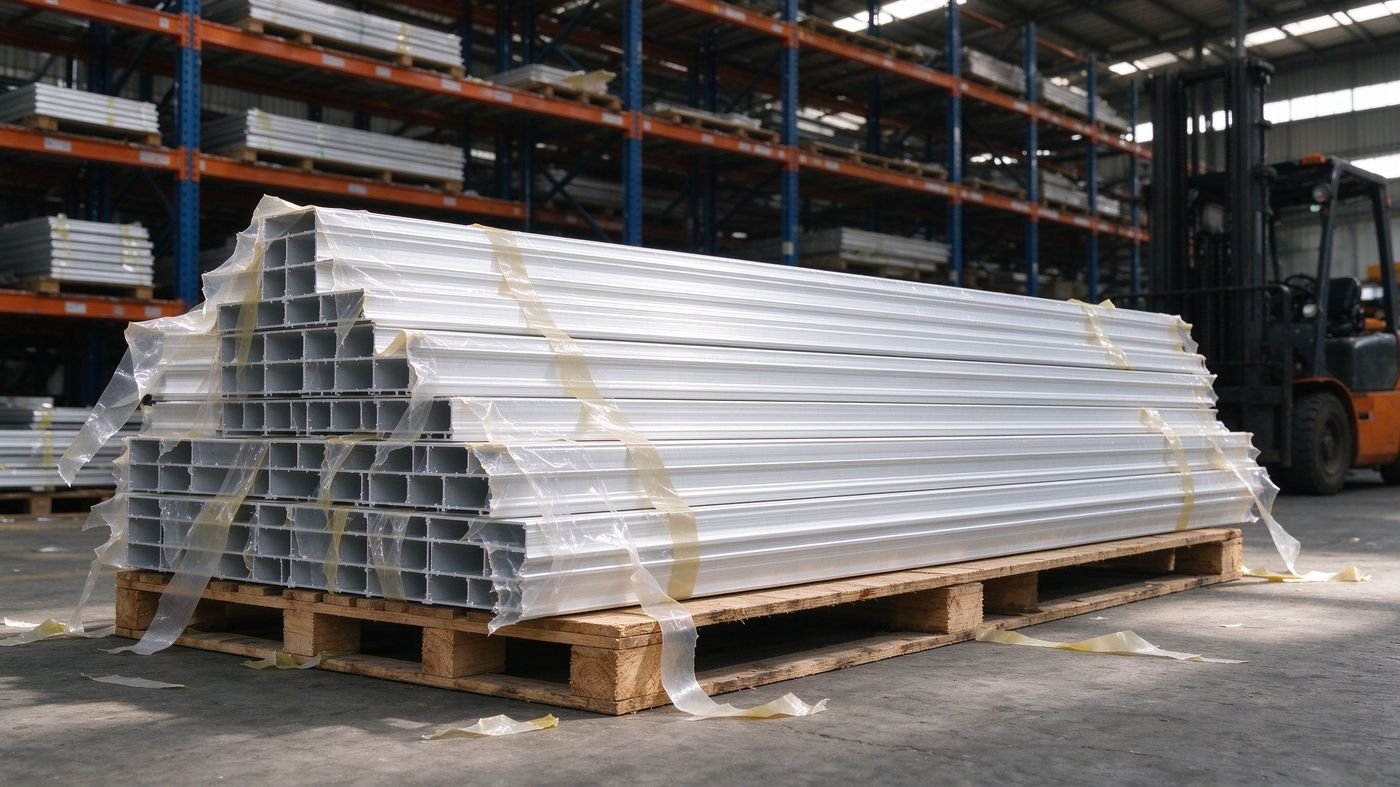
Symptom. The film is fine along the length of the profile and curled or lifted at the ends, especially at mitred or notched ends, at corners of ACP sheets, and anywhere the film wraps around an edge. Under the lifted flap there is dirt, swarf or a scuff.
What actually happened. The film was applied flat and the geometry fights it. A film wrapped around a sharp edge has almost no contact area on the radius and full contact on both faces; the edge itself is a stress concentration. Add transport vibration, bundling straps, and repeated handling, and the flap opens. Once open, it becomes a scoop: every movement pushes dust and chips under the film, and the next consequence is abrasion marks that look like film failure but are actually debris trapped under it.
- Strapping is a peel machine. Bands tensioned over film at a corner load the edge continuously for the whole journey.
- Cold film is stiff film. Applied cold, it cannot conform to a radius, so it bridges and then lifts.
- Long profiles flex. A six-meter bundle bows in a truck; the film on the compression side buckles and lifts.
Who owns it. Packaging and logistics, mostly. The film supplier’s share is whether the film was specified with adequate conformability and edge behaviour for that profile geometry.
The check. Wrap a sample, strap it as you would ship it, then shake the bundle the way a truck will. Inspect the ends first — they are your leading indicator, and they are cheap to inspect.
Failure 7: Film that dies on the façade
Symptom. Panels installed with film left on for protection during construction, exposed to sun for months. The film embrittles, yellows, cracks along the grain, and comes away in fragments, leaving adhesive behind on the powder coat or the fluorocarbon finish. Cleaning that residue off a finished façade is expensive, and on textured or matte coatings it sometimes cannot be fully removed.
What actually happened. A temporary film was used as a semi-permanent one. UV exposure degrades most PE backings over time, adhesive migrates and cross-links, and the film’s elongation falls until handling breaks it. On aluminum the consequence is worse than on steel because façade panels are usually the most visible, most expensive finished surface on the project and are rarely replaceable.
- “UV stabilized” is a duration statement, not a guarantee. Ask for the exposure window, not the word.
- Dark coatings get hotter. A dark bronze or black powder coat in sun can run far above air temperature, and film ages by temperature as much as by UV.
- Film left on for scaffolding and site protection is exactly the use case where the removal date is nobody’s job.
Who owns it. The installer and the project’s protection plan, with the film supplier responsible for stating a realistic outdoor window. If the removal date was never written down, that is the root cause.
The check. Write the removal date on the bundle ticket, not just in the specification. Then verify one panel after the longest expected exposure before the rest of the façade follows.
Who owns which failure
| Failure | Primary owner | Film supplier’s share | First evidence to ask for |
| 1. Coating pull-off | Coater / fabricator | Adhesion suitability for that coating | Back of the peeled film: residue or paint flakes |
| 2. Black spots / bloom | Storage, transport, cleaning | Honest limits, no corrosion claim | White-cloth wipe test before filming |
| 3. Rib lines on coil | Converting / winding line | Thickness and stiffness fit | Tension profile and unwind condition |
| 4. Ghost shading on anodized | Sealing sequence / duration | Stated removal window | Whether sealing preceded filming |
| 5. Cut-edge gumming | Production engineering | Backing type for hot cuts | The film’s own cut edge after one test part |
| 6. Edge lift at ends | Packaging and logistics | Conformability at edges | A strapped bundle after transport simulation |
| 7. Film dies on façade | Installer / protection plan | Real outdoor exposure window | The written removal date |
The sixty-second check that catches most of them
One incoming roll, one scrap panel, one minute. This is the same sequence we recommend for any coated metal, and on aluminum it is the fastest way to stop a claim before it grows into a container.
- Look at the roll, not the metal. Unwind a meter. Wrinkles, telescoping and edge damage in the film will become marks in the finish.
- Wipe the surface you are about to film. A clean white cloth with neutral cleaner. Grey, soapy or tacky means the surface is not ready — stop and fix cleaning, not the film.
- Film a scrap of the same coating, same cure, same day. Not the mill finish, not a different color, not yesterday’s offcut.
- Peel by hand at a shallow angle. Read the back of the film: adhesive residue is yours to raise with the film supplier, coating flakes are the coater’s, both means both.
- Look under raking light. Any shape that appears only at a glancing angle is a shading risk, and it will be worse on site than in the workshop.
If you cannot run step three because the coating sample does not exist, that is the real finding: your incoming inspection is testing a surface you do not actually ship.
Match the film to the coating, not to the word “aluminum”
| Surface | What the film must handle | What to avoid |
| Mill / extruded profile | Abrasion in handling, edge conformability, clean removal | Adhesion specified for coated surfaces |
| Anodized (clear or color) | Low-residue adhesive, short window, no pore contamination | Filming before sealing; long hot storage |
| Powder coated | Peel strength below the coating’s adhesion, correct cure | High-tack film; peeling cold and fast |
| Fluorocarbon / PVDF finish | Chemical neutrality, UV window, clean release from a smooth finish | Aggressive solvents on the film; overlong site exposure |
| Coil-coated sheet / ACP | Even tension, low pressure transfer, thickness stability | Thin film at high tension; warm winding |
| Parts that will be cut, routed or welded | Heat resistance, non-PVC backing, clean burn-back | PVC backing on hot cuts; leaving film in the weld zone |
If your order mixes several of these surfaces, the film should be specified per surface, not per shipment. That is why we ask which coating you are running before we quote a tack level — and why a single “aluminum film” catalog number is usually a compromise that fails on at least one of them.
For the coil-coated and ACP side specifically, our protective film for aluminum composite panel is built around winding behaviour rather than tack alone. For PVC profiles that share a line with aluminum, see PE aluminum film for PVC profile and our note on surface protection across PVC and aluminum in construction.
Six things we don’t recommend
- Don’t treat a protection film as a corrosion barrier. It is a handling barrier. On aluminum in humid storage, a badly applied film can make localized corrosion worse.
- Don’t film an unsealed anodized surface. Fix the sequence; do not buy a different adhesive to compensate.
- Don’t cut or weld through PVC-backed film. The hydrogen chloride issue is a corrosion risk, not a cosmetic one.
- Don’t specify tack by habit across mill, anodized and coated stock. Three surfaces, three answers.
- Don’t leave film on façade panels without a written removal date. “Until handover” is not a date.
- Don’t accept “it’s the film’s fault” without reading the back of the peeled film. The residue tells you which layer failed.
If you also run stainless, the failure patterns are different enough that they deserve their own article — ours is seven stainless steel film failures on the shop floor. And if the problem is residue rather than coating, the causes are catalogued in protective film residue: causes and solutions.
FAQ
Why did the film pull the powder coat off the aluminum?
Because the film’s adhesive had more peel strength than the coating had adhesion to the substrate, and the weaker bond failed first. That usually points to an under- or over-cured coating, contamination before coating, an adhesion level specified for a bare mill finish, or a peel done fast at ninety degrees. The back of the peeled film tells you which: adhesive residue means the film, coating flakes mean the coater.
Is a protection film enough to stop aluminum corrosion in storage?
No, and it should not be sold that way. A film keeps abrasion and dirt off; it is not a corrosion barrier. In humid or coastal storage, water trapped in film wrinkles and lifted edges can concentrate chloride and cause pitting that would not have happened on dry, ventilated metal. Clean, dry, fully contacted film in ventilated storage is the realistic target.
Should anodized profiles be filmed before or after sealing?
After sealing, and with a stated removal window. Anodized aluminum is a porous oxide; anything occupying the pores before sealing changes how they seal and how the surface scatters light, which is exactly the ghost shading customers report. If film is going on before sealing for line reasons, that is a sequence decision someone should own explicitly.
Are the rib lines on our coated coil a paint defect?
Usually not. Evenly spaced transverse lines are a pressure record of the winding: tension that is uneven across the width, warm coils, or wrinkles that double the film onto one line. Check the film itself under raking light on unwind — if the film is wrinkled, the mark is already being made and the paint is only reporting it.
Can we cut aluminum with the film still on?
Yes for mechanical cutting, if the backing is specified for it, and the test is one scrap part: look at the film’s cut edge. A soft fringe is normal; a hard bead, a welded curl or a dark burn means the film is wrong for that operation. For plasma and laser, a PVC backing is the wrong choice on both counts — it softens early and releases hydrogen chloride against freshly cut aluminum.
How long can film stay on aluminum façade panels?
We quote it as an exposure window rather than a single number, because it depends on the backing’s UV stabilization, the adhesive, the coating color and the site. Dark coatings in sun run well above air temperature, which ages film faster than UV alone. The practical rule: write the removal date on the bundle ticket, and verify one panel at the longest expected exposure before the rest of the façade follows.
Send us the panel, not the story
If an aluminum surface has already failed, the fastest path to a real answer is a coated offcut with the film still on it, the film roll’s lot number, and one line on how long the film was on and at what temperature. With those three things we can usually tell you within a day whether the failure sits in the film, the coating, the application or the storage — and which of the seven above you are looking at.
Tell us your alloy, your surface treatment, your cutting operations and your storage conditions, and we will specify the film for the coating you actually run instead of the word “aluminum” on the purchase order. Send us your process details and we will come back with a film recommendation and the checks to run on the first roll.