Three Films, Three Jobs
PE, PET, and PVC are the three workhorses of surface protection, but they are not interchangeable. Each has a different balance of flexibility, clarity, conformability, and cost. Choosing the right base film for your surface and process is the difference between protection that pays for itself and protection that causes rejects.
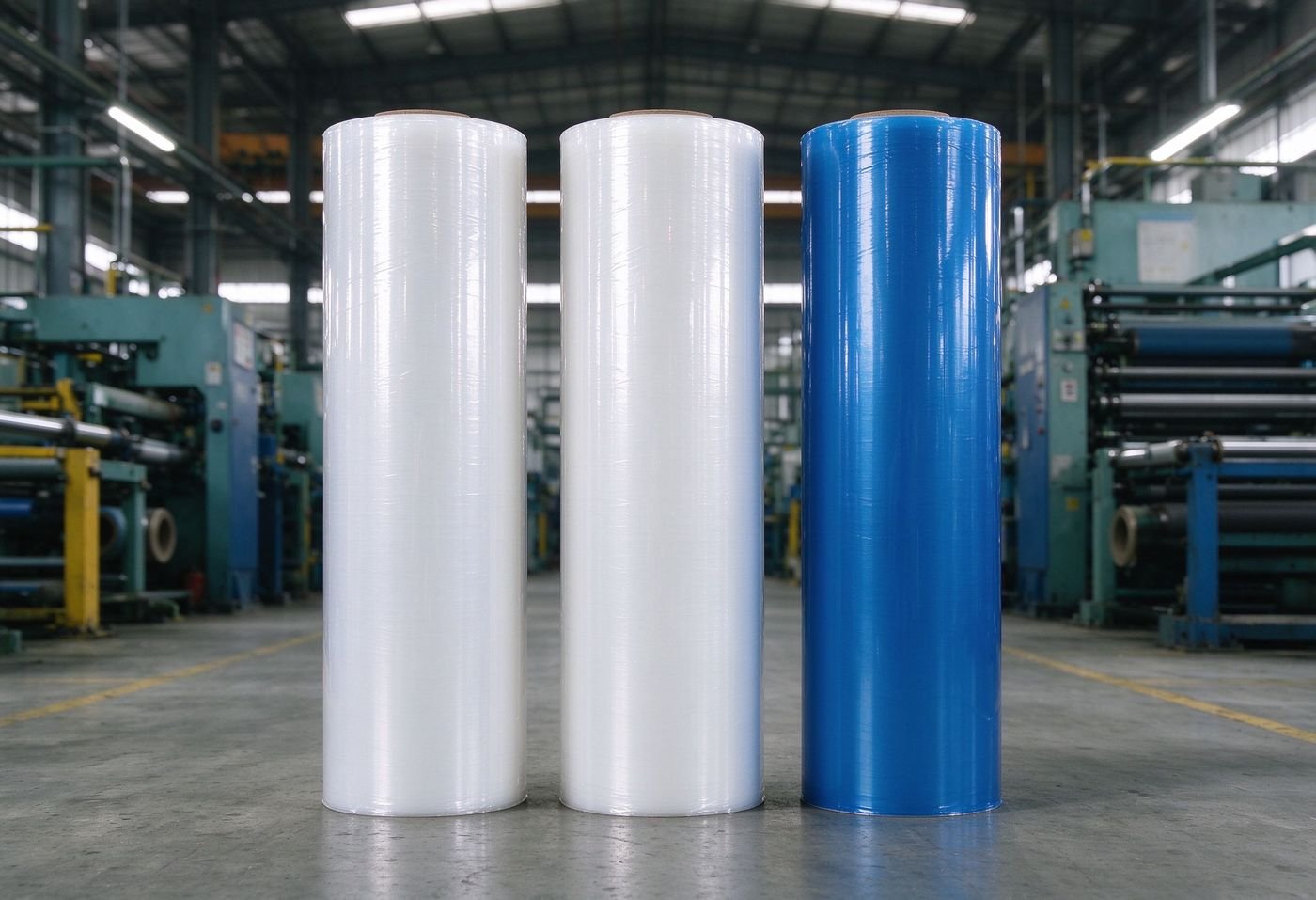
PE: Flexible Protection for Everyday Surfaces
PE (polyethylene) film is the most economical choice. It is soft, flexible, and conforms well to curves, making it the standard for aluminum profiles, furniture panels, and appliance bodies. PE film protects against scratches and dirt during processing and transport, and it comes in clear, white, blue, and black for easy identification. Use PE when cost matters and the surface is not optically critical.
PET: Strength and Clarity for Precision Surfaces
PET (polyester) film is stiffer and stronger than PE, with superior clarity and dimensional stability. It resists punctures and tears during handling, which is why electronics, glass, and display manufacturers use it. PET film holds tight edges on flat panels and removes cleanly. Choose PET for glossy, optically sensitive, or high-value surfaces where PE would not give enough protection.
PVC: Conformability for Complex Shapes
PVC (polyvinyl chloride) film offers excellent conformability and a soft touch, ideal for deep-drawn shapes, profiles with tight radii, and parts that need film to stay wrapped around edges. PVC is often used in automotive interiors and complex extrusions. It sits between PE and PET in cost. If a shape is too complex for PE and too flexible for PET, PVC is usually the answer.
How to Decide
Match the film to the failure you are preventing. Scratches during bending or assembly on a curved profile: choose PVC for conformability. Punctures on a flat sheet during transport: choose PET for strength. Cost-sensitive volume parts with light protection needs: choose PE. When in doubt, test all three on your actual line and measure rejects.
FAQ
Which film is strongest?
PET is the strongest and most puncture-resistant of the three, followed by PVC, then PE. Strength is the main reason PET is used on glass and electronics.
Is PE film good enough for aluminum profiles?
Yes. PE is the industry standard for aluminum profiles and sheets because it is economical, flexible, and protects against the main scratches and dirt risks.
Can I print on these films?
Yes. All three accept printing for logos and handling instructions. PE and PET print well with surface treatment; PVC prints directly.
See our full PE, PET and PVC surface protective film range: Read more